
Find the case that fits now
The most similar past incident may not be the most useful. What if search could take today's equipment, conditions, and resources into account?


On this page
Imagine a field-service technician arriving at a site where a pump has begun vibrating. She searches the service history and finds a familiar incident: the same model, the same symptom, and a successful repair.
Then she opens the report. The earlier repair took place during a planned shutdown, with a replacement assembly and a specialist on site. Today, she has a portable inspection kit, no replacement assembly, and a machine operating under heavy load.
The case resembles her problem. It offers little help with her immediate question: what should she investigate next?
A different report describes a related pump operating under similar conditions. Its inspection sequence helped a technician narrow the cause with the tools she has today. Finding that report could give her a better starting point.
The distinction is familiar to anyone who consults past experience. “Have we seen something like this?” and “Which experience helps us now?” can lead to different answers.
The same history, a different question
Our technician has several kinds of information: equipment details, observations, operating conditions, and the resources available for this visit. Past reports may contain corresponding details, along with actions and outcomes. The useful comparison crosses all of them.
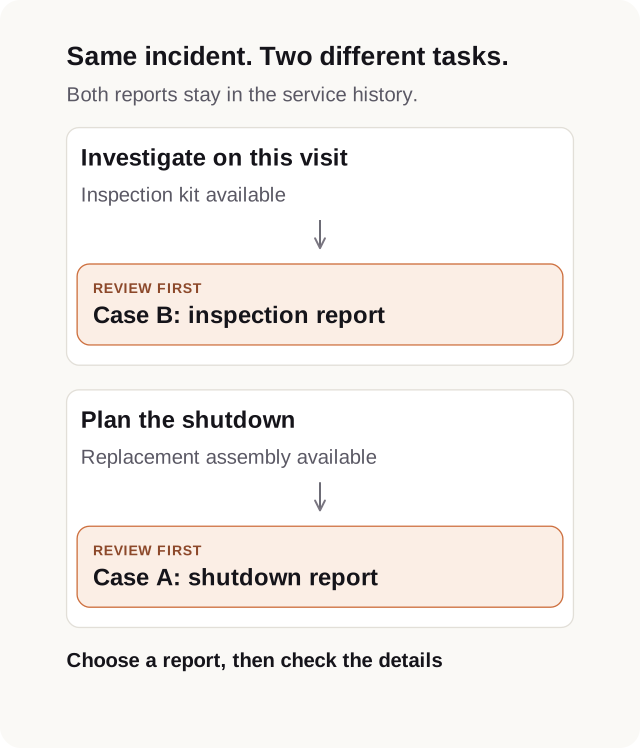
Call the shutdown report Case A and the inspection report Case B. If she is planning a replacement next month, Case A could be the first report worth reading. If she is deciding what to investigate on this visit, Case B could deserve attention first. Neither report needs to change. The reason for consulting them has changed.
Search filters can help her select an equipment family or a date range. They answer questions about which records are eligible. A further question remains: among eligible records, which similarities matter most for this task?
Suppose search first returns ten reports based mainly on equipment and symptom wording. Removing the ones that require unavailable parts may leave a cleaner list. But if Case B never entered those ten, filtering can’t bring it back. Current circumstances need a way to influence which cases become candidates, as well as their order.
How HDC could compare the whole situation
Hyperdimensional computing (HDC) offers one way to represent structured situations for comparison. It encodes information into long patterns called hypervectors. HDC operations can combine values with their roles in a situation: which equipment was involved, what condition was observed, or which resource was available. We could then compare these combinations across reports.
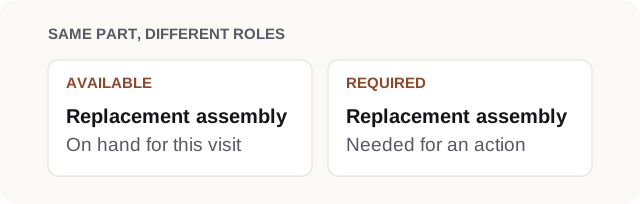
1. Keep each detail’s role. “Replacement assembly available” should carry a different meaning from “replacement assembly required.” A useful representation would preserve that distinction. We could then compare the technician’s available kit with the tools used in Case B, while keeping the replacement requirements in Case A separate.
2. Let the task change what matters. The proposed search could keep separate, compatible representations of equipment and symptoms, operating conditions, and resources for each case. Her current task would determine how much each comparison contributes to the ranking. Investigating today could emphasize comparable conditions and feasible inspection work. Planning the shutdown could give more importance to the equipment configuration and replacement requirements.
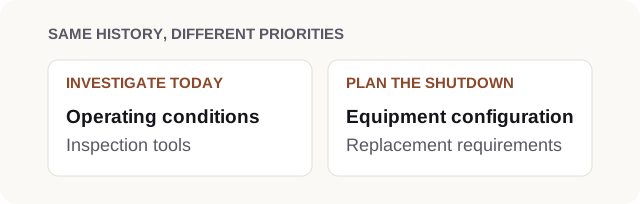
3. Use those priorities to find candidates. We’d apply the comparison across the eligible history before choosing a shortlist. Case A’s equipment match could carry less weight for today’s visit than Case B’s comparable conditions and inspection work. Case B would have a route into the results even if an equipment-and-symptom search left it out.
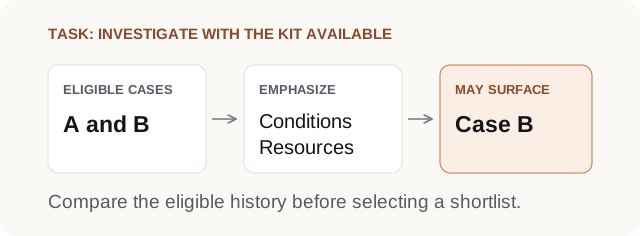
This is a concrete way HDC could contribute: comparing combinations of recorded relationships while letting the task change their relative importance. Whether those priorities bring useful cases into the shortlist would need testing with real reports.
For this two-case example, a weighted search over database fields could express the same priorities. HDC becomes an option to investigate as the combinations grow: several observations under different operating conditions, tools used in different inspection steps, and parts available or required for different actions. Its role-and-value operations offer a way to compose those relationships into patterns we can compare.
The service team would still need to define which relationships to preserve and what counts as useful agreement. We’d need to compare the resulting search with a simpler weighted approach to find out whether HDC helps people retrieve useful precedents.
Check the case before using it
Now let’s imagine the technician receiving Case B with a short explanation grounded in its service report: related equipment, comparable operating conditions, and an inspection sequence using an available kit. Beside it, she can open the original observations, the steps taken, and the recorded outcome.
She still needs to check the differences. Was the equipment revision compatible? Were the operating limits comparable? Did the earlier technician confirm a cause, or merely record a suspicion? A missing condition should appear as unknown, giving her a reason to ask or inspect further.
Available resources also play two roles. They can help rank useful reading, and they can impose firm limits on an action. Required qualifications, approved procedures, and equipment restrictions need explicit checks. A strong resemblance can’t compensate for an unmet requirement.
Later, a shutdown is scheduled and the replacement assembly arrives. The same technician could change the task and find Case A more useful. The history would remain intact, while the search would reflect the decision she now faces.
Where else does “relevant now” matter?
A customer-support specialist may see the same error message across several cases, but need a precedent for the customer’s software version and access permissions. Context could bring forward an investigation the customer can actually carry out. Version compatibility would still need checking before applying a fix.
A logistics coordinator looking at a delayed shipment may find yesterday’s closest match unhelpful because today’s delivery window and alternative capacity are different. Searching those circumstances together could surface a more useful recovery example. Current capacity would need confirmation because the historical record can’t establish what’s available today.
Bring a case where the obvious match was unhelpful
An especially useful starting point is a pair of examples: the case search found and the case an experienced colleague wished it had found. The difference often reveals which relationships the search needs to take seriously.
If your team has incident reports or case histories and can describe why relevance changes, talk with HDC Labs. Bring a recurring search problem, an example of the information you already record, and the decision you want to make more easily. We can explore whether HDC could help your team find the experience that fits now.